
BDC Exposure To CoreWeave Inc.
October 20, 2026
NEWS
CoreWeave — the "neocloud" that rents out Nvidia GPU capacity to the likes of Meta, OpenAI and Microsoft — has had a rough few weeks in the press and the market. Its stock fell more than 20% in the week to October 16, including a 15.5% drop on October 15 after Bloomberg reported that its unsecured notes due in 2032 were changing hands below 80 cents on the dollar. Those bonds, due 2031 and 2032, have since been quoted at 76.5 to 81 cents, at yields of 15% to 16%, and five-year credit default swaps on the company blew out to a record of roughly 1,200 basis points — a level implying something like a 60% probability of default within five years. MoffettNathanson cut its price target from $107 to $89, citing "staggering financial obligations," and Gartner has publicly warned about the neocloud business model.
The debt behind those headlines is considerable. CoreWeave carries some $35 billion of funded debt — approaching $50 billion counting leases and other commitments — against revenue guidance of $12.4 to $13.2 billion for the year. Interest alone ran $640 million in the second quarter; capital spending guidance runs as high as $39 billion; and $4.4 billion of debt matures by the end of 2026, with another $6.2 billion due in 2027. Most of the stack — roughly $30 billion — is asset-based financing: delayed-draw term loans housed in special-purpose vehicles, secured against GPU clusters and customer contracts. As Reuters Breakingviews pointed out on October 16, each vintage has been weaker than the last: the DDTL 4.0 facility was investment grade at SOFR+225, while DDTL 5.5, arranged in August, is junk-rated at SOFR+550 and is backed by customer contracts running three years against a five-year loan. The bulls answer that revenue more than doubled in the second quarter and the contracted backlog exceeds $104 billion, including Meta's $14.2 billion commitment, with Nvidia agreeing to buy back unsold capacity through 2032. The bears' question is simpler: what the GPUs and those contracts are actually worth if the price of AI compute keeps falling?
BDC EXPOSURE
Given the negative headlines, we thought it might be useful to determine both the aggregate amount of BDC exposure to CoreWeave, and its related entities, and the form of those obligations. In this regard, we leaned on Solve's "BDC Holdings" database and turned up the following:
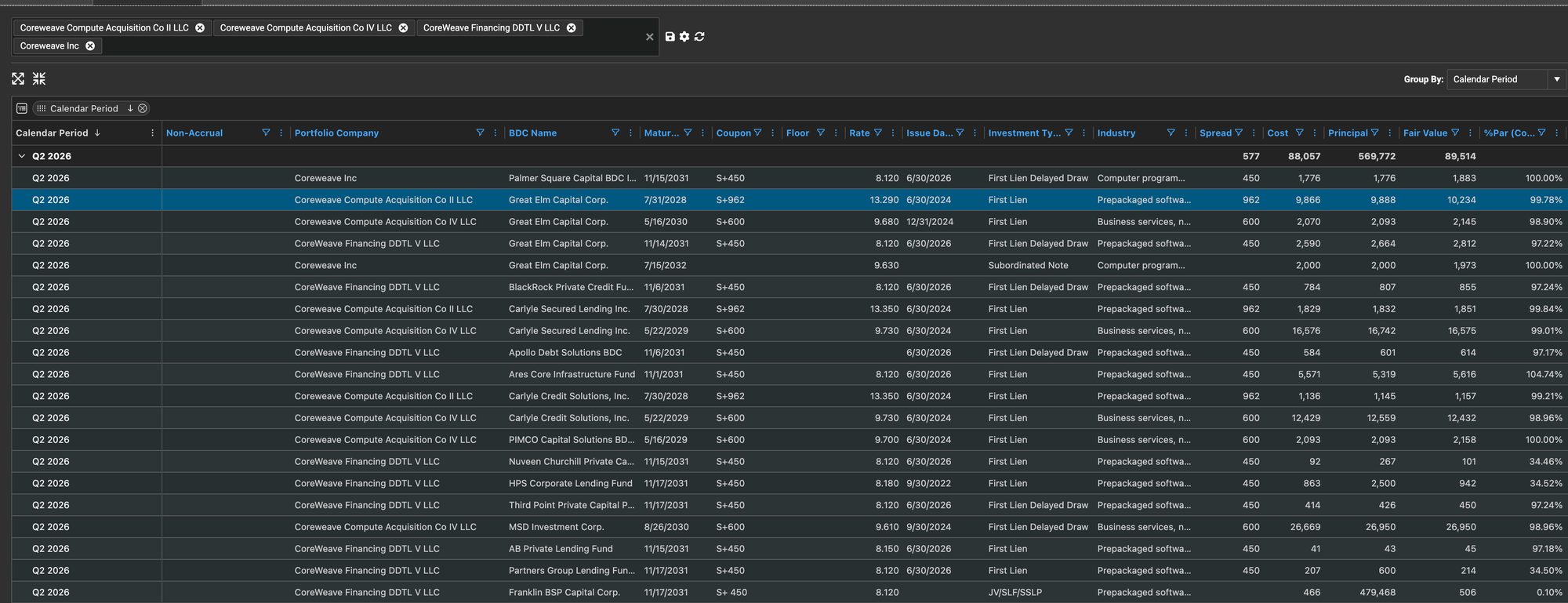
The total amount invested, virtually all in first lien debt, is relatively modest by BDC standards: $88mn at cost. That's insignificant in a BDC universe with an AUM at cost of $567bn.
The FMV is slightly higher than the aggregate cost, with no mark-downs of any significance as of June 2026, the latest data available.
Even more noteworthy is how many different BDCs - both public and private - are lenders to the overall CoreWeave complex. We count 15 different players, including 3 public BDCs: Palmer Square (PSBD), Great Elm (GECC) and Carlyle Secured Lending (CGBD).
Also worth noting is that BDC exposure dropped sharply in the IIQ 2026 from the levels earlier in the year. See below.

Only a tiny sliver of BDC exposure is to CoreWeave directly. That's GECC's $2mn subordinated note, due in 2032 and PSBD's first lien Delayed Draw Term Loan, which matures in 2031. The rest of the BDC funds have been lent to the asset-supported CoreWeave "Special Purpose Vehicles" (SPV), all with relatively short remaining maturities ranging between 2028 and 2031.
Of course, both the amounts invested at cost and FMV date back to June 2026. The numbers might change when the IIIQ 2026 BDC results begin to appear. However, based on the evidence so far there's no reason to be concerned either about aggregate BDC exposure to CoreWeave or about any individual BDC. We should note, though, that GECC's exposure is on the high side for a BDC of its size: 9% at cost.
We'll keep tracking the relationship between the BDC sector and CoreWeave. However, at the moment, there is no cause for even mild alarm. More trouble is likely in BDC-financed Dental Service Organizations (see our recent article on ADG, LLC) than in this "neocloud" AI service business.
Member discussion