
Bloomberg Warns of a "Total Meltdown" In The Riskiest Debt. Should We Worry About The BDCs?
October 25, 2026
NEWS
The average risk premium for US high-yield debt had climbed to a 17-month high and primary markets notched the year’s biggest spate of pulled deals...Yields on the riskiest junk borrowers, rated CCC, this week surged to their highest since the pandemic, as the spread they command over Treasuries ballooned to a four-year high. While software has been the focus for much of this year because of fears over the disruptive powers of AI, cable and satellite companies have been the biggest laggards in this portion of the market.
“The price action has been eye-watering in a lot of situations,” said Green, founder and chief investment officer of London-based credit investor Pearlstone Alternative. “Into year-end, primary markets are effectively shut. And there isn’t a lot of liquidity on the way down, so that is exacerbating the panic.”
Yields on junk bonds rated CCC have risen steadily since March, when the US and Israel were launching their first strikes on Iran. But they’ve spiked aggressively since September as a selloff in Treasuries boosted benchmark borrowing costs, and investors started to become more nervous about risks associated with the mountain of AI-related financing to be sold, including by companies already groaning under heavy debtloads.
In lockstep with rising stress in junk bonds, the deeply distressed tail of the leveraged loan universe has grown to levels not seen since the beginning of the pandemic. The volume of loans trading below 60 cents on the dollar, signaling deep distress, in September was at its highest since March 2020, according to a research note from JPMorgan Chase & Co. The amount of loans trading at or below 80 cents on the dollar surged almost 90% in the past 12 months, the strategists wrote.
It is unusual for CCC spreads to blow out so much while the rest of the credit market remains generally stable. The differential between CCC and the higher-rated tier of BB spreads is the widest its been since the pandemic.
Bloomberg- By Aaron Weinman, Josie Reich, and Paula Sambo- October 24, 2026
ANALYSIS
Bloomberg's headline writers can tend to be overly dramatic. The article that the above extracts come from led with this: "‘Total Meltdown’ in Riskiest Debt Unnerves Market". What is a "total meltdown" after all? Nonetheless, there are reasons for anyone involved in the public BDC sector to be worried about the recent trends in both the high yield and leveraged loan markets. This is especially apposite as BDC earnings season begins on Tuesday, with the release of Ares Capital's (ARCC) IIIQ 2026 results.
The evidence suggests that i) the deterioration in the value of the weaker borrowers in BDC portfolios in the June-September period could weigh on net asset value calculations; ii) the even sharper downturn in the first three weeks of the fourth quarter might quickly render the September 30 numbers obsolete and result in even larger losses in the IIVQ 2026 results, which we won't see till late January of next year.
Ever Wider
Here's the data we found that caused us unduly high concern. Let's start with the trend in spreads where CCC and below bonds are concerned.
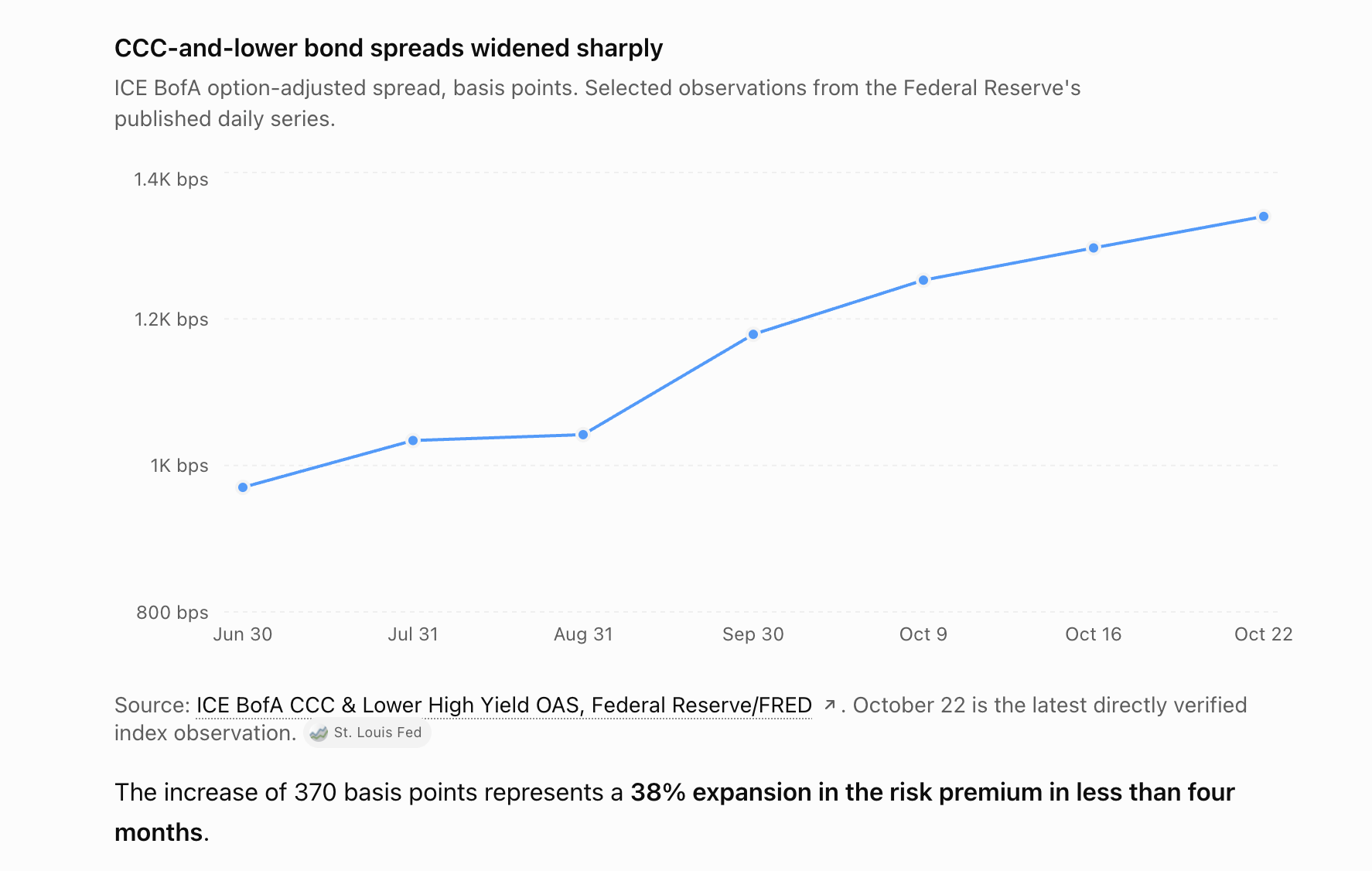
By way of comparison, as of October 22, the broader US high-yield index was yielding a risk premium of approximately 340 basis points. Thus, CCC-rated debt carried nearly four times the spread of the high-yield market overall.
Signal
Of course, BDCs do not invest in the high yield market but it's a useful reference point.
Closer To Home
More directly, a recent Morningstar study is said to have claimed that "... CCC-rated loan spreads widened to levels associated with the aftermath of the 2020 pandemic selloff" in the IIIQ 2026.
Another striking finding comes from EdgePoint's in a October 22 analysis, using Bank of America research:
CCC-rated leveraged loans produced approximately negative 6% total returns during the first nine months of 2026, even while the overall loan market was generating positive returns. This is a year-to-date figure, not the Q3 change alone.
A J.P. Morgan October 16 credit research report concluded that CCC-rated leveraged loans had lost approximately 2.31% in October through that date, compared with a decline of only approximately 0.21% for the broader leveraged-loan market.
Impact
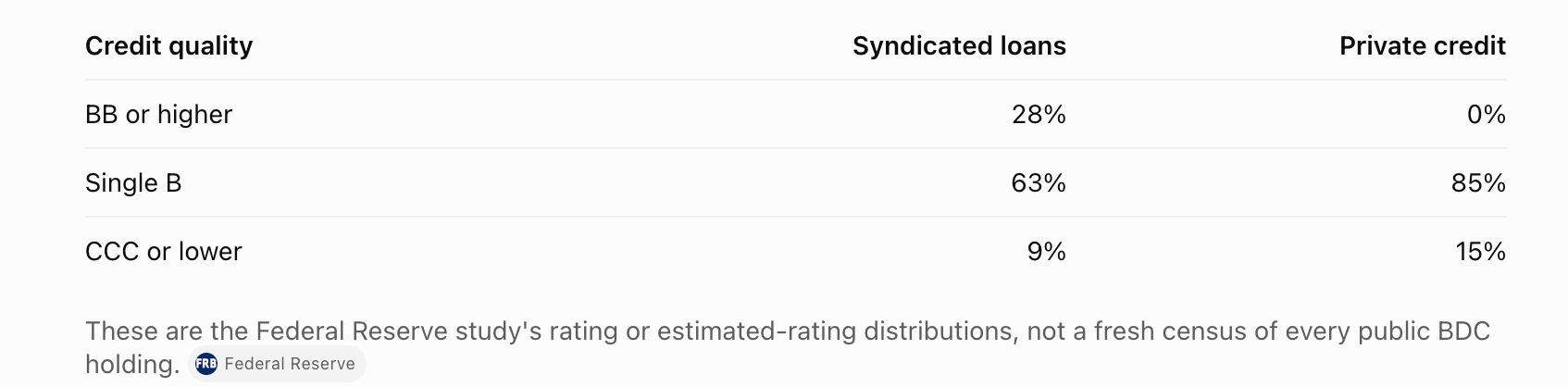
To us,the data clearly indicates that markets are unusually jittery about their weakest borrowers. Private Credit lenders, which include BDCs, have a relatively high percentage of these more troubled assets, as this chart from the Feceral Reserve shows:
Bespoke Research
We have assembled our own data on "weaker" investments in public BDC portfolios, relying both on their own calculations where available and our independent calculations. Roughly speaking, any investment valued at less than 90% of cost is cause for concern and becomes even more pertinent when valued below 80%.
As of June 2026, there were several BDCs with underperforming assets greater than 15% of their total portfolio. If only loans were to be included in the calculations, the percentage was even higher. To be fair, though, many other BDCs claimed underperformers only accounted for a small slice of their total. ARCC estimated the percentage was 5%, but New Mountain Finance (NMFC) admitted to 18% and FS-KKR Capital (FSK) to 10%.
Our own estimates sometimes mirror the BDC's own, but can also be higher or lower. For example, we calculate that 6% of ARCC's portfolio is underperforming and FSK's 14%.
Filtering Down
The bottom line, though, is that every BDC has some number of weaker investments on their books and they are likely to have been more written down in September than in June and are dropping further in October. As always, the results will vary widely by BDC, both due to the varying composition of their portfolios but also due to differing valuation methodologies.
Result
The bottom line is that there's a possibility BDC portfolio values could be, in many cases, be lower overall in the IIIQ 2026 than in the prior period due to the deterioration of this minority of weaker credits. If October's trends continue, or worsen, that deterioration would extend to the December 2026 results.
Even Worse?
More worrying than lower values in a 10-Q is Bloomberg's suggestion - to quote one market participant - that:
“Into year-end, primary markets are effectively shut. And there isn’t a lot of liquidity on the way down, so that is exacerbating the panic.”
Keeping Calm And Carrying On
However, nobody is yet claiming that the more distressed borrowers will be unable to attract any refinancing in either the junk bond or leveraged loan market when push comes to shove.
The Worse Case
Nonetheless, if the current market anxiety about CCC (and below) borrowers continues, it's hard to imagine would-be borrowers being able to tap the debt markets for new monies. This would lead to a pick-up in the number of restructurings and liability management exercises (LME), which would put ever greater pressure on lenders, including the public BDCs we are concerned about.
To The Watchtower
This is a tricky period and a strange one because better-rated credits (B and higher) continue to perform well valuation-wise and when needing to access new funds even as the weaker loans are being drastically written down.
We'll be keeping a close eye on market developments, if only to get an early warning as to what might happen to the value and financeability of a broad swathe of BDC assets. We're trying to avoid any dramatics, but this is a subject where the earliest advance notice is critical for anyone concerned with the health of the BDC market.
Member discussion